TCP/IP replication client class. More...
#include <replicatetcpclient.h>
 Collaboration diagram for SOCKET_INITIALIZER_MIXIN: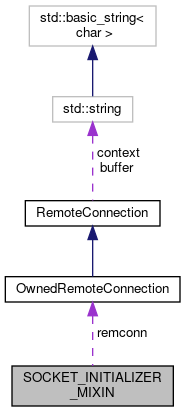
Public Member Functions | |
| ReplicateTcpClient (const std::string &hostname, int port, double timeout_connect, double socket_timeout) | |
| Constructor. More... | |
| void | update_from_master (const std::string &path, const std::string &remotedb, Xapian::ReplicationInfo &info, double reader_close_time, bool force_copy) |
| ~ReplicateTcpClient () | |
| Destructor. More... | |
| TcpServer (const std::string &host, int port, bool tcp_nodelay, bool verbose_) | |
| Construct a TcpServer and start listening for connections. More... | |
| ~TcpServer () | |
| Destructor. More... | |
| void | run () |
| Accept connections and service requests indefinitely. More... | |
| void | run_once () |
| Accept a single connection, service requests on it, then stop. More... | |
| bool | get_verbose () const |
| Should we produce output when connections are made or lost? More... | |
| virtual void | handle_one_connection (int socket)=0 |
| Handle a single connection on an already connected socket. More... | |
Protected Member Functions | |
| int | accept_connection () |
| Accept a connection and return the file descriptor for it. More... | |
Protected Attributes | |
| bool | verbose |
| Should we produce output when connections are made or lost? More... | |
Private Member Functions | |
| void | operator= (const ReplicateTcpClient &) |
| Don't allow assignment. More... | |
| ReplicateTcpClient (const ReplicateTcpClient &) | |
| Don't allow copying. More... | |
| TcpServer & | operator= (const TcpServer &)=delete |
| Don't allow assignment. More... | |
| TcpServer (const TcpServer &)=delete | |
| Don't allow copying. More... | |
Static Private Member Functions | |
| static int | open_socket (const std::string &hostname, int port, double timeout_connect) |
| Attempt to open a TCP/IP socket connection to a replication server. More... | |
Private Attributes | |
| int | socket |
| The socket fd. More... | |
| OwnedRemoteConnection | remconn |
| Write-only connection to the server. More... | |
| int | listener |
| The socket we're listening on. More... | |
Detailed Description
TCP/IP replication client class.
Generic TCP/IP socket based server base class.
Definition at line 37 of file replicatetcpclient.h.
Constructor & Destructor Documentation
◆ ~ReplicateTcpClient()
| SOCKET_INITIALIZER_MIXIN::~ReplicateTcpClient | ( | ) |
Destructor.
◆ ~TcpServer()
| SOCKET_INITIALIZER_MIXIN::~TcpServer | ( | ) |
Destructor.
Note: We don't need a virtual destructor despite having a virtual method as we don't ever delete a subclass using a pointer to the base class.
Member Function Documentation
◆ accept_connection()
|
protected |
Accept a connection and return the file descriptor for it.
◆ get_verbose()
|
inline |
Should we produce output when connections are made or lost?
Definition at line 87 of file tcpserver.h.
References verbose.
◆ handle_one_connection()
|
pure virtual |
Handle a single connection on an already connected socket.
◆ open_socket()
|
staticprivate |
Attempt to open a TCP/IP socket connection to a replication server.
Connect to replication server running on port port of host hostname. Give up trying to connect after timeout_connect seconds.
Note: this method is called early on during class construction before any member variables or even the base class have been initialised. To help avoid accidentally trying to use member variables or call other methods which do, this method has been deliberately made "static".
◆ operator=() [1/2]
|
private |
Don't allow assignment.
◆ operator=() [2/2]
Don't allow assignment.
◆ ReplicateTcpClient() [1/2]
|
private |
Don't allow copying.
◆ ReplicateTcpClient() [2/2]
| SOCKET_INITIALIZER_MIXIN::ReplicateTcpClient | ( | const std::string & | hostname, |
| int | port, | ||
| double | timeout_connect, | ||
| double | socket_timeout | ||
| ) |
Constructor.
Connect to replication server running on port port of host hostname. Give up trying to connect after timeout_connect seconds.
- Parameters
-
timeout_connect Timeout for trying to connect (in seconds). socket_timeout Socket timeout (in seconds); 0 for no timeout.
◆ run()
| void SOCKET_INITIALIZER_MIXIN::run | ( | ) |
Accept connections and service requests indefinitely.
This method runs the TcpServer as a daemon which accepts a connection and forks itself (or creates a new thread under Windows) to serve the request while continuing to listen for more connections.
◆ run_once()
| void SOCKET_INITIALIZER_MIXIN::run_once | ( | ) |
Accept a single connection, service requests on it, then stop.
◆ TcpServer() [1/2]
| SOCKET_INITIALIZER_MIXIN::TcpServer | ( | const std::string & | host, |
| int | port, | ||
| bool | tcp_nodelay, | ||
| bool | verbose_ | ||
| ) |
Construct a TcpServer and start listening for connections.
- Parameters
-
host The hostname or address for the interface to listen on (or "" to listen on all interfaces). port The TCP port number to listen on. tcp_nodelay If true, enable TCP_NODELAY option. verbose Should we produce output when connections are made or lost?
◆ TcpServer() [2/2]
|
privatedelete |
Don't allow copying.
◆ update_from_master()
| void SOCKET_INITIALIZER_MIXIN::update_from_master | ( | const std::string & | path, |
| const std::string & | remotedb, | ||
| Xapian::ReplicationInfo & | info, | ||
| double | reader_close_time, | ||
| bool | force_copy | ||
| ) |
Member Data Documentation
◆ listener
|
private |
The socket we're listening on.
Definition at line 44 of file tcpserver.h.
◆ remconn
|
private |
Write-only connection to the server.
Definition at line 48 of file replicatetcpclient.h.
◆ socket
|
private |
The socket fd.
Definition at line 45 of file replicatetcpclient.h.
◆ verbose
|
protected |
Should we produce output when connections are made or lost?
Definition at line 48 of file tcpserver.h.
The documentation for this class was generated from the following files:
- net/replicatetcpclient.h
- net/tcpserver.h