 Inheritance diagram for MyPostingSource2:
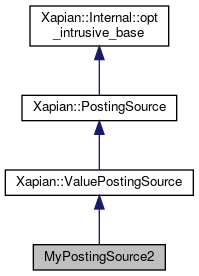 Collaboration diagram for MyPostingSource2:
Public Member Functions | |
| MyPostingSource2 (const std::string &desc_) | |
| MyPostingSource2 * | clone () const |
| Clone the posting source. More... | |
| std::string | name () const |
| Name of the posting source class. More... | |
| std::string | serialise () const |
| Serialise object parameters into a string. More... | |
| MyPostingSource2 * | unserialise (const std::string &s) const |
| Create object given string serialisation returned by serialise(). More... | |
| double | get_weight () const |
| Return the weight contribution for the current document. More... | |
| std::string | get_description () const |
| Return a string describing this object. More... | |
| Public Member Functions inherited from Xapian::ValuePostingSource | |
| ValuePostingSource (Xapian::valueno slot_) | |
| Construct a ValuePostingSource. More... | |
| Xapian::doccount | get_termfreq_min () const |
| A lower bound on the number of documents this object can return. More... | |
| Xapian::doccount | get_termfreq_est () const |
| An estimate of the number of documents this object can return. More... | |
| Xapian::doccount | get_termfreq_max () const |
| An upper bound on the number of documents this object can return. More... | |
| void | next (double min_wt) |
| Advance the current position to the next matching document. More... | |
| void | skip_to (Xapian::docid min_docid, double min_wt) |
| Advance to the specified docid. More... | |
| bool | check (Xapian::docid min_docid, double min_wt) |
| Check if the specified docid occurs. More... | |
| bool | at_end () const |
| Return true if the current position is past the last entry in this list. More... | |
| Xapian::docid | get_docid () const |
| Return the current docid. More... | |
| void | init (const Database &db_) |
| Set this PostingSource to the start of the list of postings. More... | |
| Xapian::Database | get_database () const |
| The database we're reading values from. More... | |
| Xapian::valueno | get_slot () const |
| The slot we're reading values from. More... | |
| std::string | get_value () const |
| Read current value. More... | |
| void | done () |
| End the iteration. More... | |
| bool | get_started () const |
| Flag indicating if we've started (true if we have). More... | |
| void | set_termfreq_min (Xapian::doccount termfreq_min_) |
| Set a lower bound on the term frequency. More... | |
| void | set_termfreq_est (Xapian::doccount termfreq_est_) |
| An estimate of the term frequency. More... | |
| void | set_termfreq_max (Xapian::doccount termfreq_max_) |
| An upper bound on the term frequency. More... | |
| Public Member Functions inherited from Xapian::PostingSource | |
| PostingSource () | |
| Allow subclasses to be instantiated. More... | |
| virtual | ~PostingSource () |
| void | set_maxweight (double max_weight) |
| Specify an upper bound on what get_weight() will return from now on. More... | |
| double | get_maxweight () const |
| Return the currently set upper bound on what get_weight() can return. More... | |
| virtual PostingSource * | unserialise_with_registry (const std::string &serialised, const Registry ®istry) const |
| Create object given string serialisation returned by serialise(). More... | |
| PostingSource * | release () |
| Start reference counting this object. More... | |
| const PostingSource * | release () const |
| Start reference counting this object. More... | |
| Public Member Functions inherited from Xapian::Internal::opt_intrusive_base | |
| opt_intrusive_base (const opt_intrusive_base &) | |
| opt_intrusive_base & | operator= (const opt_intrusive_base &) |
| opt_intrusive_base () | |
| Construct object which is initially not reference counted. More... | |
| virtual | ~opt_intrusive_base () |
| void | ref () const |
| void | unref () const |
Private Attributes | |
| std::string | desc |
Additional Inherited Members | |
| Public Attributes inherited from Xapian::Internal::opt_intrusive_base | |
| unsigned | _refs |
| Reference count. More... | |
| Protected Member Functions inherited from Xapian::Internal::opt_intrusive_base | |
| void | release () const |
| Start reference counting. More... | |
| Protected Attributes inherited from Xapian::ValuePostingSource | |
| Xapian::Database & | db |
| The database we're reading values from. More... | |
| Xapian::valueno & | slot |
| The slot we're reading values from. More... | |
| Xapian::ValueIterator & | value_it |
| Value stream iterator. More... | |
| bool & | started |
| Flag indicating if we've started (true if we have). More... | |
| Xapian::doccount & | termfreq_min |
| A lower bound on the term frequency. More... | |
| Xapian::doccount & | termfreq_est |
| An estimate of the term frequency. More... | |
| Xapian::doccount & | termfreq_max |
| An upper bound on the term frequency. More... | |
Detailed Description
Definition at line 262 of file api_serialise.cc.
Constructor & Destructor Documentation
◆ MyPostingSource2()
|
inline |
Definition at line 265 of file api_serialise.cc.
Member Function Documentation
◆ clone()
|
inlinevirtual |
Clone the posting source.
The clone should inherit the configuration of the parent, but need not inherit the state. ie, the clone does not need to be in the same iteration position as the original: the matcher will always call init() on the clone before attempting to move the iterator, or read the information about the current position of the iterator.
This may return NULL to indicate that cloning is not supported. In this case, the PostingSource may only be used with a single-database search.
The default implementation returns NULL.
Note that the returned object will be deallocated by Xapian after use with "delete". If you want to handle the deletion in a special way (for example when wrapping the Xapian API for use from another language) then you can define a static operator delete method in your subclass as shown here: https://trac.xapian.org/ticket/554#comment:1
Reimplemented from Xapian::PostingSource.
Definition at line 270 of file api_serialise.cc.
◆ get_description()
|
inlinevirtual |
Return a string describing this object.
This default implementation returns a generic answer. This default it provided to avoid forcing those deriving their own PostingSource subclass from having to implement this (they may not care what get_description() gives for their subclass).
Reimplemented from Xapian::PostingSource.
Definition at line 289 of file api_serialise.cc.
◆ get_weight()
|
inlinevirtual |
Return the weight contribution for the current document.
This default implementation always returns 0, for convenience when implementing "weight-less" PostingSource subclasses.
This method may assume that it will only be called when there is a "current document". In detail: Xapian will always call init() on a PostingSource before calling this for the first time. It will also only call this if the PostingSource reports that it is pointing to a valid document (ie, it will not call it before calling at least one of next(), skip_to() or check(), and will ensure that the PostingSource is not at the end by calling at_end()).
Reimplemented from Xapian::PostingSource.
Definition at line 287 of file api_serialise.cc.
◆ name()
|
inlinevirtual |
Name of the posting source class.
This is used when serialising and unserialising posting sources; for example, for performing remote searches.
If the subclass is in a C++ namespace, the namespace should be included in the name, using "::" as a separator. For example, for a PostingSource subclass called "FooPostingSource" in the "Xapian" namespace the result of this call should be "Xapian::FooPostingSource".
This should only be implemented if serialise() and unserialise() are also implemented. The default implementation returns an empty string.
If this returns an empty string, Xapian will assume that serialise() and unserialise() are not implemented.
Reimplemented from Xapian::PostingSource.
Definition at line 275 of file api_serialise.cc.
◆ serialise()
|
inlinevirtual |
Serialise object parameters into a string.
The serialised parameters should represent the configuration of the posting source, but need not (indeed, should not) represent the current iteration state.
If you don't want to support the remote backend, you can use the default implementation which simply throws Xapian::UnimplementedError.
Reimplemented from Xapian::PostingSource.
Definition at line 279 of file api_serialise.cc.
◆ unserialise()
|
inlinevirtual |
Create object given string serialisation returned by serialise().
Note that the returned object will be deallocated by Xapian after use with "delete". If you want to handle the deletion in a special way (for example when wrapping the Xapian API for use from another language) then you can define a static operator delete method in your subclass as shown here: https://trac.xapian.org/ticket/554#comment:1
If you don't want to support the remote backend, you can use the default implementation which simply throws Xapian::UnimplementedError.
- Parameters
-
serialised A serialised instance of this PostingSource subclass.
Reimplemented from Xapian::PostingSource.
Definition at line 283 of file api_serialise.cc.
Member Data Documentation
◆ desc
|
private |
Definition at line 263 of file api_serialise.cc.
The documentation for this class was generated from the following file:
- tests/api_serialise.cc