Class for iterating over document values. More...
#include <valueiterator.h>
 Collaboration diagram for Xapian::ValueIterator: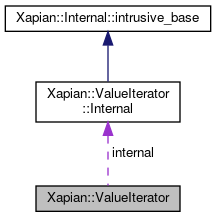
Classes | |
| class | Internal |
| Abstract base class for value streams. More... | |
Public Member Functions | |
| ValueIterator (const ValueIterator &o) | |
| Copy constructor. More... | |
| ValueIterator & | operator= (const ValueIterator &o) |
| Assignment. More... | |
| ValueIterator () | |
| Default constructor. More... | |
| ~ValueIterator () | |
| Destructor. More... | |
| std::string | operator* () const |
| Return the value at the current position. More... | |
| ValueIterator & | operator++ () |
| Advance the iterator to the next position. More... | |
| DerefWrapper_< std::string > | operator++ (int) |
| Advance the iterator to the next position (postfix version). More... | |
| Xapian::docid | get_docid () const |
| Return the docid at the current position. More... | |
| Xapian::valueno | get_valueno () const |
| Return the value slot number for the current position. More... | |
| void | skip_to (Xapian::docid docid_or_slot) |
| Advance the iterator to document id or value slot docid_or_slot. More... | |
| bool | check (Xapian::docid docid) |
| Check if the specified docid occurs. More... | |
| std::string | get_description () const |
| Return a string describing this object. More... | |
Private Types | |
| typedef std::input_iterator_tag | iterator_category |
| typedef std::string | value_type |
| typedef Xapian::doccount_diff | difference_type |
| typedef std::string * | pointer |
| typedef std::string & | reference |
Private Member Functions | |
| void | decref () |
| ValueIterator (Internal *internal_) | |
Private Attributes | |
| Internal * | internal |
Detailed Description
Class for iterating over document values.
Definition at line 40 of file valueiterator.h.
Member Typedef Documentation
◆ difference_type
|
private |
ValueIterator is what the C++ STL calls an input_iterator.
The following typedefs allow std::iterator_traits<> to work so that this iterator can be used with the STL.
These are deliberately hidden from the Doxygen-generated docs, as the machinery here isn't interesting to API users. They just need to know that Xapian iterator classes are compatible with the STL.
Definition at line 195 of file valueiterator.h.
◆ iterator_category
|
private |
ValueIterator is what the C++ STL calls an input_iterator.
The following typedefs allow std::iterator_traits<> to work so that this iterator can be used with the STL.
These are deliberately hidden from the Doxygen-generated docs, as the machinery here isn't interesting to API users. They just need to know that Xapian iterator classes are compatible with the STL.
Definition at line 191 of file valueiterator.h.
◆ pointer
|
private |
ValueIterator is what the C++ STL calls an input_iterator.
The following typedefs allow std::iterator_traits<> to work so that this iterator can be used with the STL.
These are deliberately hidden from the Doxygen-generated docs, as the machinery here isn't interesting to API users. They just need to know that Xapian iterator classes are compatible with the STL.
Definition at line 197 of file valueiterator.h.
◆ reference
|
private |
ValueIterator is what the C++ STL calls an input_iterator.
The following typedefs allow std::iterator_traits<> to work so that this iterator can be used with the STL.
These are deliberately hidden from the Doxygen-generated docs, as the machinery here isn't interesting to API users. They just need to know that Xapian iterator classes are compatible with the STL.
Definition at line 199 of file valueiterator.h.
◆ value_type
|
private |
ValueIterator is what the C++ STL calls an input_iterator.
The following typedefs allow std::iterator_traits<> to work so that this iterator can be used with the STL.
These are deliberately hidden from the Doxygen-generated docs, as the machinery here isn't interesting to API users. They just need to know that Xapian iterator classes are compatible with the STL.
Definition at line 193 of file valueiterator.h.
Constructor & Destructor Documentation
◆ ValueIterator() [1/3]
|
explicitprivate |
Construct given internals.
Definition at line 41 of file valueiterator.cc.
References Assert, Xapian::ValueIterator::Internal::at_end(), decref(), internal, and LOGCALL_CTOR.
◆ ValueIterator() [2/3]
| Xapian::ValueIterator::ValueIterator | ( | const ValueIterator & | o | ) |
◆ ValueIterator() [3/3]
|
inline |
Default constructor.
Creates an uninitialised iterator, which can't be used before being assigned to, but is sometimes syntactically convenient.
Definition at line 81 of file valueiterator.h.
◆ ~ValueIterator()
|
inline |
Member Function Documentation
◆ check()
| bool Xapian::ValueIterator::check | ( | Xapian::docid | docid | ) |
Check if the specified docid occurs.
The caller is required to ensure that the specified document id did actually exists in the database.
This method acts like skip_to() if that can be done at little extra cost, in which case it then returns true. This is how chert and glass databases behave because they store values in streams which allow for an efficient implementation of skip_to().
Otherwise it simply checks if a particular docid is present. If it is, it returns true. If it isn't, it returns false, and leaves the position unspecified (and hence the result of calling methods which depend on the current position, such as get_docid(), are also unspecified). In this state, next() will advance to the first matching position after document did, and skip_to() will act as it would if the position was the first matching position after document did.
Currently the inmemory and remote backends behave in the latter way because they don't support streamed values and so skip_to() must check each document it skips over which is significantly slower.
- Parameters
-
docid The document id to check.
Definition at line 131 of file valueiterator.cc.
References Xapian::ValueIterator::Internal::at_end(), Xapian::ValueIterator::Internal::check(), decref(), internal, LOGCALL, and RETURN.
Referenced by Xapian::ValuePostingSource::check(), and DEFINE_TESTCASE().
◆ decref()
|
private |
Definition at line 34 of file valueiterator.cc.
References Assert.
Referenced by check(), operator++(), operator=(), skip_to(), and ValueIterator().
◆ get_description()
| std::string Xapian::ValueIterator::get_description | ( | ) | const |
Return a string describing this object.
Definition at line 145 of file valueiterator.cc.
◆ get_docid()
| Xapian::docid Xapian::ValueIterator::get_docid | ( | ) | const |
Return the docid at the current position.
If we're iterating over values of a document, this method will throw Xapian::InvalidOperationError.
Definition at line 102 of file valueiterator.cc.
References Assert, Xapian::ValueIterator::Internal::get_docid(), internal, LOGCALL, and RETURN.
Referenced by DEFINE_TESTCASE(), Xapian::ValuePostingSource::get_docid(), and main().
◆ get_valueno()
| Xapian::valueno Xapian::ValueIterator::get_valueno | ( | ) | const |
Return the value slot number for the current position.
If the iterator is over all values in a slot, this returns that slot's number. If the iterator is over the values in a particular document, it returns the number of each slot in turn.
Definition at line 110 of file valueiterator.cc.
References Assert, Xapian::ValueIterator::Internal::get_valueno(), internal, LOGCALL, and RETURN.
Referenced by ChertValueManager::add_document(), GlassValueManager::add_document(), DEFINE_TESTCASE(), InMemoryDatabase::finish_add_doc(), serialise_document(), and show_values().
◆ operator*()
| string Xapian::ValueIterator::operator* | ( | ) | const |
Return the value at the current position.
Definition at line 81 of file valueiterator.cc.
References Assert, Xapian::ValueIterator::Internal::get_value(), internal, LOGCALL, and RETURN.
◆ operator++() [1/2]
| ValueIterator & Xapian::ValueIterator::operator++ | ( | ) |
Advance the iterator to the next position.
Definition at line 89 of file valueiterator.cc.
References Assert, Xapian::ValueIterator::Internal::at_end(), decref(), internal, LOGCALL, and RETURN.
◆ operator++() [2/2]
|
inline |
Advance the iterator to the next position (postfix version).
Definition at line 96 of file valueiterator.h.
◆ operator=()
| ValueIterator & Xapian::ValueIterator::operator= | ( | const ValueIterator & | o | ) |
Assignment.
Definition at line 69 of file valueiterator.cc.
References Xapian::Internal::intrusive_base::_refs, decref(), internal, LOGCALL, and RETURN.
◆ skip_to()
| void Xapian::ValueIterator::skip_to | ( | Xapian::docid | docid_or_slot | ) |
Advance the iterator to document id or value slot docid_or_slot.
If this iterator is over values in a document, then this method advances the iterator to value slot docid_or_slot, or the first slot after it if there is no value in slot slot.
If this iterator is over values in a particular slot, then this method advances the iterator to document id docid_or_slot, or the first document id after it if there is no value in the slot we're iterating over for document docid_or_slot.
Note: The "two-faced" nature of this method is due to how C++ overloading works. Xapian::docid and Xapian::valueno are both typedefs for the same unsigned integer type, so overloading can't distinguish them.
- Parameters
-
docid_or_slot The docid/slot to advance to.
Definition at line 118 of file valueiterator.cc.
References Xapian::ValueIterator::Internal::at_end(), decref(), internal, and LOGCALL_VOID.
Referenced by DEFINE_TESTCASE(), and Xapian::ValuePostingSource::skip_to().
Member Data Documentation
◆ internal
|
private |
Reference counted internals.
Definition at line 45 of file valueiterator.h.
Referenced by check(), get_docid(), get_valueno(), Xapian::iterator_valid(), operator*(), operator++(), operator=(), skip_to(), and ValueIterator().
The documentation for this class was generated from the following files:
- include/xapian/valueiterator.h
- api/valueiterator.cc